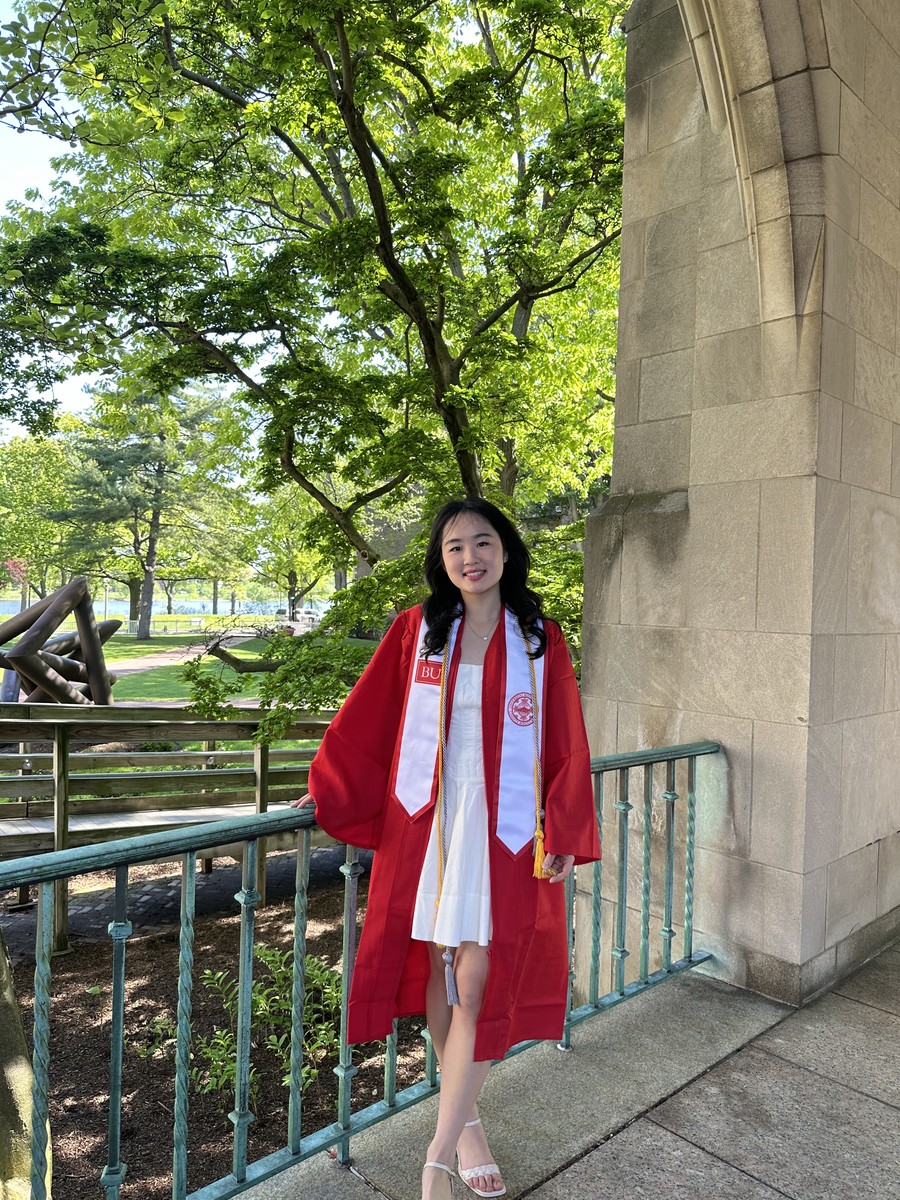
Boston University’ 26 | Researcher in Biostatistics & Computational Methods
Email: titigao [at] bu [dot] edu
GitHub: TianyiGao616
LinkedIn: tianyi-gao
About
I’m a recent graduate of Boston University, where I received a B.A. in Mathematics and Computer Science. My research interests broadly lie in applying statistics and computational methods to address health problems, especially those related to complex diseases. I will begin graduate studies in the Master of Science (ScM) in Biostatistics program at the Johns Hopkins School of Public Health.
Research Interests
I’m broadly interested in:
- Deep learning, artificial intelligence, and machine learning
- Causal inference
- Genetics and genomics
- Longitudinal methods and survival analysis
- Medical image analysis
Research Experience
Below are selected research projects I have worked on:
Boston University, Department of Biostatistics
- Researcher (2026–Present)
- Conducting research on Alzheimer’s disease using longitudinal data from the Alzheimer’s Disease Neuroimaging Initiative (ADNI).
- Studying longitudinal datasets with substantial missingness and evaluating how different imputation methods affect classification model performance.
Boston University, Department of Biostatistics
- Research Assistant, with Ningyuan Wang and Prof. Ching-Ti Liu (2025–Present)
- Working on high-dimensional heterogeneous mediation analysis methods
- Implemented large-scale simulation studies using HPC on BU SCC and computed error metrics to evaluate the performance of different mediation methods
- Contributing to the development of an R package for the mediation method
- Currently transferring large-scale datasets to BU SCC for future analyses
Boston University, Department of Mathematics and Statistics
- Independent Researcher for Undergraduate Honors Thesis, with Dr. Matthew Moore (2025)
- Modeled ecological and epidemiological systems using ODE-based predator–prey models
- Extended the classical two-species Lotka–Volterra model to a general n-species framework
- Incorporated logistic growth terms and analyzed the resulting dynamical system
- Performed stability and phase-plane analysis of the generalized models
- Estimated model coefficients using three regression methods and evaluated estimation accuracy using statistical metrics
Boston University, Department of Mathematics and Statistics
- Research Assistant, with Prof. Mark Kon (2025)
- Built an ensemble machine learning pipeline for cancer classification using high-dimensional gene expression data (500 samples, 30k genes).
- Applied SVM as base learners and Random Forest, Decision Tree, and Logistic Regression models as metalearners to identify biologically meaningful gene pathways.
- Achieved 95% accuracy and extracted top 10–20 genes per meta-learner for biological interpretation.
- Project code available on GitHub: Repository Link.
Teaching and Mentoring
I am passionate about teaching and enjoy helping students learn and grow. I worked as a Teaching Assistant for Analysis of Variance (MA 416) in Fall 2025. Starting in Fall 2022, I tutored middle and high school students in China in AP Calculus and the TOEFL exam. I also worked as a Peer Mentor at CAS, where I supported first-year students by offering academic guidance and advice on course planning and university life.
Presentations and Conferences
- Presented my honors thesis, “Modeling Ecological and Epidemiological Systems Using Predator–Prey Dynamics”, at the Undergraduate Research Opportunities Program (UROP) Symposium, Fall 2025.
- Successfully defended my undergraduate honors thesis before the Department of Mathematics faculty committee in December 2025.